Kyoto Snacks 101: 5 Matcha-Country Treats You Can Order in the US
Kyoto was Japan’s capital for a thousand years, and it snacks like it: quiet flavors, old shops, and one ingredient above all. The tea fields of Uji, just south of the city, have grown Japan’s most prized matcha for centuries — which means Kyoto is the reason “matcha flavor” exists as a category at all.
This is the next stop in our regional series: five Kyoto-coded treats you can order in the US, from the gateway Kit Kat to the powder itself.
1. The matcha Kit Kat: where the flavor craze started
Japan’s flavored Kit Kats are famous, but matcha is the one that conquered the world — and the serious versions name their source: Uji, Kyoto’s tea country. Nestlé Japan even makes editions with Kyoto tea houses whose names go on the box, a co-sign Japanese shoppers actually check for.
A good matcha Kit Kat is not a green candy bar. It leads with the tea — a little grassy, a little bitter — and lets the white chocolate do the sweetening. If you’ve only had matcha in latte form, this is the cheapest possible field trip.
2. Yatsuhashi: cinnamon, the Kyoto way
Kyoto’s signature souvenir is yatsuhashi — a thin rice-flour sweet flavored with nikki, Japanese cinnamon. It comes two ways. The baked version is a crisp, curved cookie that keeps for weeks and ships fine. The soft, unbaked version (nama yatsuhashi, folded around red-bean paste) is what every school trip to Kyoto brings home — but it only lasts days, so it mostly stays in Japan.
The cinnamon here is cooler and sharper than the American cinnamon-roll kind. It tastes old-fashioned in the best sense, like something served with tea in a room with paper windows — which is exactly what it is.
3. Konpeito: tiny sugar stars from the old capital
Konpeito are small star-shaped sugar candies, introduced by Portuguese traders in the 1500s and adopted so thoroughly that Kyoto still has shops that make almost nothing else. Each batch tumbles in a heated pan for days while syrup builds up the spikes — a genuinely absurd amount of craft for a candy the size of a pea.
The taste is simple sugar with light fruit or tea flavors; the point is the sparkle. They’re the standard “little gift from Japan,” and a jar on a desk disappears faster than anyone admits.
4. Uji matcha powder: the real thing
At some point the matcha Kit Kats send you up the mountain: actual Uji matcha, whisked into hot water or dumped honestly into a latte. Kyoto’s tea merchants — some centuries old, a few with US storefronts now — sell tins of the same powder used in tea ceremony.
Two words to know. Culinary grade is for lattes, baking, and ice cream: cheaper, more bitter, made to fight through milk and sugar. Ceremonial grade is for drinking straight. Start culinary; graduate if it becomes a habit. It will.
5. Hojicha sweets: the toasty sibling
Hojicha is green tea roasted until it turns amber — the bitterness drops out and a toasty, caramel-adjacent flavor takes over. Kyoto shops popularized it, and it’s quietly becoming the next matcha: hojicha lattes, hojicha chocolate, hojicha candy.
If matcha reads as too grassy for you, hojicha is the on-ramp. It pairs with milk the way coffee does, minus most of the caffeine punch.
The ones that stay in Kyoto
Buying matcha from the US: read this first
That’s Kyoto: the region where “snack” and “tea ceremony” are the same conversation. The series continues on our regional page — Hokkaido’s dairy empire is already covered. Prefer someone else doing the hunting? Monthly boxes love shipping matcha sweets; see the Bokksu vs Sakuraco vs TokyoTreat showdown.
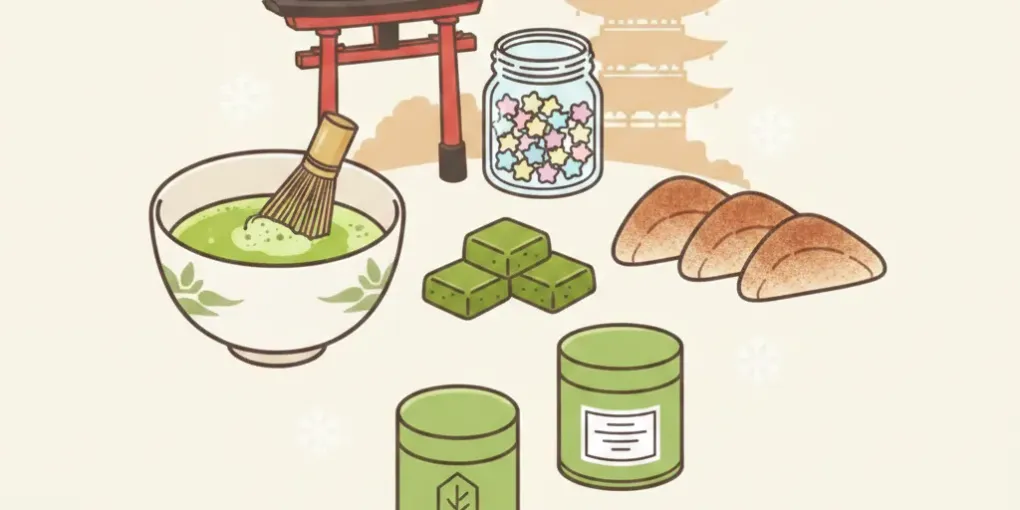
The hero image is an original illustration, not a product photo.